Buying land in Spain is an exciting first step towards building a home that suits your lifestyle. On the Costa Blanca, the right plot can offer Mediterranean views, outdoor living and a climate that makes terraces and gardens part of everyday life.
However, a plot that looks ideal may come with planning restrictions, technical challenges or extra costs. Before committing to a purchase, check what you can build, whether the land is legally suitable for your plans and how much the whole project is likely to cost. These checks can help you avoid expensive surprises later.
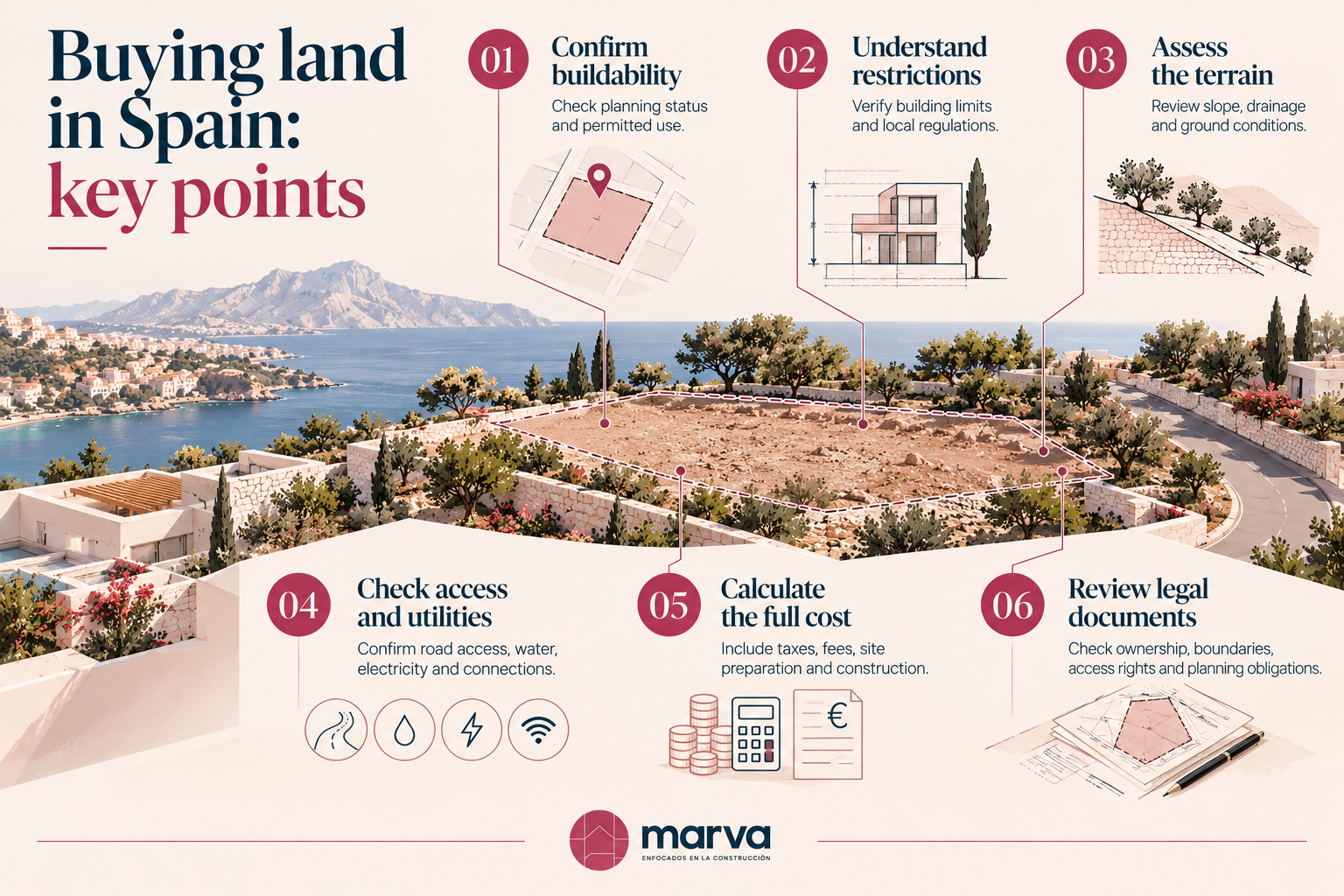
What to consider before buying land in Spain: 6 steps
1. Confirm that the land is suitable for building
A plot for sale does not automatically mean that you can build a residential villa on it. When buying land in Spain, it’s important to understand that Spanish land is subject to different planning classifications, broadly including urban land, developable land and non-developable land. The applicable rules determine what uses are permitted and under which conditions.
Ask the relevant town hall to confirm the plot’s planning status and whether residential construction is allowed. Check whether any planning requirements must be fulfilled before a building project can proceed. This is particularly important for rural plots or land near protected landscapes, where restrictions may limit development.
Do not rely solely on an estate agent’s description or the fact that nearby properties have been built. Each plot has its own circumstances, and permission to build must be assessed against current local planning rules.
2. Understand the planning restrictions
Even when residential construction is possible in principle, local regulations will shape the villa you can build. They may set limits on the buildable area, building height, number of floors, distance from boundaries and proportion of the plot that can be occupied. There may also be rules affecting parking, swimming pools and other outdoor features.
A large site is not necessarily the best choice if the permitted building area is too small for your plans. Discuss your ideas with an architect familiar with local planning rules, and remember that the final design must comply with regulations and receive the required municipal permission before construction.
3. Assess the land itself
The physical characteristics of a plot can affect both the design and the construction budget. Two sites with similar asking prices may require very different levels of preparation before building can start.
Start by looking at the slope. Steep land may provide attractive views, but it can also require excavation, retaining walls or more complex foundations. These works can add significantly to the overall cost. A geotechnical survey helps establish ground conditions and determine the type of foundations required.
Also consider drainage, orientation, sunlight, prevailing winds and the surrounding environment. On the Costa Blanca, orientation can influence natural light and how comfortable terraces and outdoor spaces are throughout the year. Views and privacy are important, but consider whether nearby land could be developed in future.
4. Check access and essential services
A plot may be suitable for building but still need substantial work before construction can begin. Confirm that it has appropriate physical and legal access from a public road. If the route crosses private land, check that the necessary access rights are properly documented.
Investigate the availability and connection requirements for water, electricity, sewage and telecommunications. Do not assume that services are available simply because neighbouring houses have them. Connection points, provider requirements and the work needed to extend infrastructure can all affect the budget.
Ask providers about connection fees and technical requirements. In remote locations, check internet and mobile coverage if you plan to work from home.
5. Calculate the total cost, not just the asking price
The cost of buying land in Spain goes beyond the purchase price. Allow for applicable purchase taxes, transaction costs, legal and professional fees, architectural services, licences and construction costs. Depending on the site, additional expenses may include earthworks, retaining walls, specialist foundations, utility connections, access improvements and landscaping.
Costs vary according to the plot’s location, condition and complexity, so avoid relying on a generic estimate. If you have a particular villa in mind, discuss it with your architect and construction team while evaluating the land.
Set aside a contingency for unforeseen expenses, and ensure the budget covers the land, preparation work and house itself.
6. Review the legal documents before signing
Before completing the purchase, make sure the documentation matches the property you believe you are buying. Check boundaries, access rights, easements and any planning obligations that could affect development.
Consider appointing an independent lawyer experienced in Spanish property transactions. They can review the documents, explain the legal implications and identify issues that should be resolved before you sign a private purchase agreement or complete the sale.
Choose a location that fits your lifestyle
When buying land in Spain, the best option is not always the one with the most spectacular view. It is the one that suits your lifestyle while meeting your practical needs and budget.
Consider travel times to shops, healthcare and other services. Visit at different times of day if possible, and pay attention to traffic, noise, privacy and nearby development.
On the Costa Blanca, places such as Moraira, Jávea, Calpe and Benissa offer different settings and property opportunities. Even within one area, orientation, access and surroundings can influence how the finished home feels and functions.
Plan your villa on the Costa Blanca with Construcciones Marva
Buying land in Spain is the first step in a larger process, and getting advice early can help you make informed decisions. Construcciones Marva has more than 50 years of experience in construction, renovation and interior design on the Costa Blanca.
We can help you assess a plot’s potential, consider practical constraints and coordinate with an architect as your project takes shape. Once the architectural project is finalised and the necessary municipal permission has been obtained, we can manage the construction process from groundworks through to the finishing details.
We value transparent communication, clear planning and a project tailored to your needs. Speaking to an experienced local team early can help you evaluate your options.
FAQs about buying land in Spain
What should foreigners know about buying land in Spain?
Foreign nationals can generally purchase land in Spain, subject to applicable legal requirements. Buying property does not automatically grant Spanish residency, so immigration matters should be considered separately.
Can I build a villa on any plot?
No. The right to build depends on the plot’s planning classification, local regulations and any restrictions affecting the land. Confirm the position with the relevant town hall before purchasing.
Should I speak to an architect before buying?
Yes, an early consultation can help you assess whether the plot is suitable for your intended design and identify potential planning or technical constraints. It does not replace formal approvals.
What should I check first when buying land in Spain?
Start by verifying planning status and permitted use. Then investigate buildable area, ground conditions, access, utilities, legal documentation and the likely total cost of the project.

Noticias relacionadas
Luxury villas in Spain with private pool: what sets them apart
A luxury villa is never defined by a swimming pool alone. The finest luxury...

What makes sea view villas in Costa Blanca so valuable
When exploring the Mediterranean property market, many buyers and investors ask the same question: what...

Sustainable building practices for our villas in Spain: top 7 ideas
Building a villa in Spain is an opportunity to create something truly lasting. Beyond...
Renovation vs new construction: Costa Blanca homes explained
Are you considering buying or building a home on the Costa Blanca? One of...
Benefits of smart homes: the future of modern villas in the Mediterranean
Mediterranean living works when homes stop getting in the way. When interiors stay comfortable...
8 key benefits of living in Spain and owning a home on the Costa Blanca
If you have ever imagined a Mediterranean lifestyle filled with sunlight, calm days and...

Renovations in Spain: how to plan a stress-free home project as an international owner
Many international homeowners with a holiday property in Spain want to carry out renovations...
Why property investment in Spain is booming on the Costa Blanca
Over the past decade, Spain has re-emerged as one of Europe’s most attractive property...