
The Costa Blanca is easy to recognise in photographs. What is harder to understand from a photograph is how differently one place can feel from another. Mediterranean villages can share the same coastline, climate and architectural influences, yet offer completely different ways of living.
A historic centre with stone façades and narrow streets. A coastal area where the marina becomes part of everyday life. A larger coastal town where apartments, villas and everyday services coexist. They are all part of the Costa Blanca, but they are not interchangeable.
This matters if you are considering Mediterranean villages in Costa Blanca as somewhere to live, buy a second home or invest in property. The municipality on the signpost is only the starting point. The exact area, street, plot and type of property can completely change the experience.
What makes Mediterranean villages different?
The word “Mediterranean” is often reduced to a visual style: white walls, stone, terraces, shutters and swimming pools. But the character of these places goes much deeper than appearance.
Look at the structure of an established village and you may find:
- A defined historic centre, often built around a church, square or traditional meeting point.
- Streets designed around pedestrians, rather than exclusively around cars.
- Buildings shaped by the local climate and terrain, rather than placed independently of them.
- A mixture of permanent residents and seasonal visitors, creating a different rhythm throughout the year.
The relationship between the built environment and its surroundings is particularly relevant when you are buying a home.
A villa on a hillside can offer privacy and views but require more driving. A property close to a historic centre can put everyday life within walking distance while offering different possibilities for parking, terraces or outdoor space.
That is why comparing Mediterranean villages in Costa Blanca requires more than comparing photographs.
Four locations, four different property experience
1. Moraira: compact, coastal and residential
Moraira has a relatively intimate scale, particularly around its centre and marina, while the surrounding residential areas introduce a different side of the municipality.
For buyers, this creates an interesting balance between proximity and privacy. You may want restaurants, shops and the seafront within easy reach. Or you may prefer a villa with more outdoor space in a quieter residential setting.
The exact plot becomes crucial. Marva’s projects include Villa Zorzal in El Portet, located around 1.2 km from Portet beach. It is a useful example of how the relationship between a house, its surroundings and the coast can define the character of a project.
2. Jávea: choose the area, not just the municipality
Jávea (Xàbia) is a good example of why the name of a municipality does not tell the whole story.
Its historic centre, port, Arenal and surrounding residential areas offer noticeably different environments. For someone looking at Mediterranean villages in Costa Blanca, that makes the choice of micro-location particularly important.
Before concentrating on individual properties, consider what you actually need from the area. Do you want to walk to everyday services? Is proximity to the sea more important than privacy? How much driving are you comfortable with? Your answers may point towards completely different parts of the same municipality.
3. Benissa: town, countryside and coastline
Benissa offers another combination of environments.
Its historic inland town has a very different relationship with local life and architecture from the more dispersed residential areas along the coast. For a property buyer, this opens up different possibilities depending on whether the priority is outdoor living, proximity to the coast or a particular type of home.
Neither setting is simply “more Mediterranean”. They represent different versions of Mediterranean living, something our Villa Sorell reflects through its coastal setting.
4. Calpe: a more urban coastal setting
Calpe (Calp) introduces another variable: scale.
It has a more developed urban environment, with a broad mixture of apartments, villas, services and coastal areas. The Peñón de Ifach also gives the landscape a particularly recognisable identity.
For some buyers, the concentration of services and wider choice of property formats can be important. For others, a smaller-scale environment may be closer to what they are looking for.
This makes Calpe relevant when comparing Mediterranean villages in Costa Blanca from a property and investment perspective, because different types of homes and locations can serve very different purposes.
Before buying a plot, look beyond the vie
A good view can be one of the reasons you fall in love with a plot. However, it shouldn’t be the only reason you buy it.
At Construcciones Marva, choosing the right plot involves looking at practical factors such as orientation, views, surroundings, access and legal viability. The company has local knowledge of Moraira, Jávea, Calpe, Benissa and other areas of the Costa Blanca, and can review a plot before a project moves forward.
Seven questions worth asking
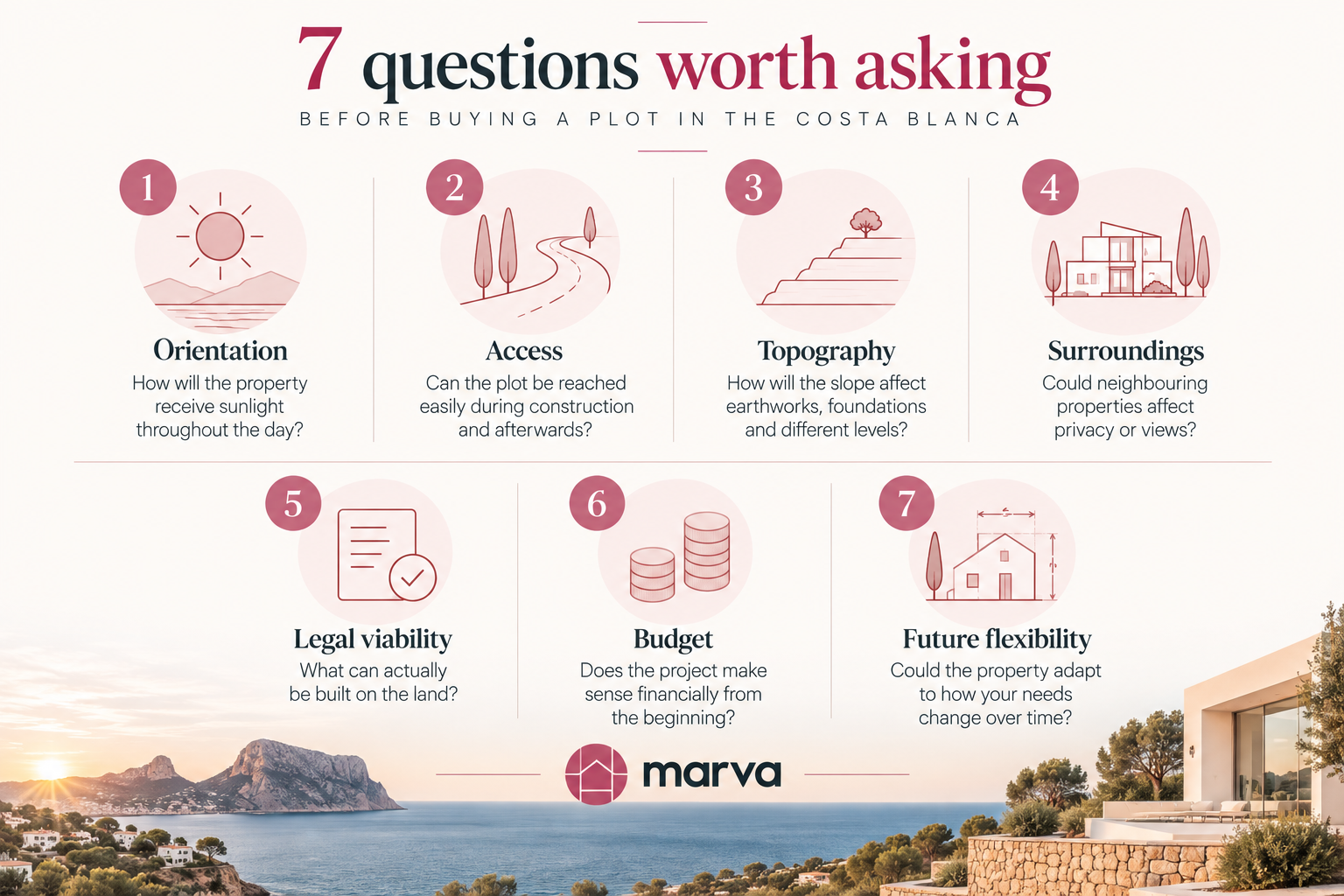
These details may seem less exciting than choosing finishes or imagining the terrace, but they can have a much greater impact on the final project in Mediterranean villages.
Think about the Costa Blanca outside August
One of the simplest ways to test a property location is to imagine yourself there when you are not on holiday. Walk around the area. Look at which businesses operate outside the busiest months. Pay attention to traffic, parking, access and the distance to the services you actually use.
Before choosing a location, ask yourself:
- Will this area work for my everyday routine?
- Can I easily reach the services I need?
- Does the property match the way I intend to use it?
There is no single way to approach Mediterranean villages in Costa Blanca. The important thing is to understand what you want the property to do for you before choosing where to build or buy it.
Local knowledge starts before construction
Choosing between Mediterranean villages in Costa Blanca is ultimately about understanding the relationship between location, land, architecture and lifestyle.
That is where local construction experience can become useful long before the first brick is laid. Marva has more than 50 years of experience in construction and works across the Costa Blanca. Our services include plot assessment, construction, renovation and interior design, while the team can also work alongside trusted architects and coordinate the construction process through to completion.
Rather than following a single formula, the aim is to understand each location and create a home that belongs there.
FAQs about buying or investing in Mediterranean villages
Which Mediterranean villages in Costa Blanca should I consider?
Moraira, Jávea, Benissa and Calpe each offer different combinations of historic character, coastal areas, residential neighbourhoods and property types. The right location depends on how you plan to use the property.
Why is the exact location important in Jávea?
Jávea contains several distinct areas with different environments and property profiles. Choosing between them can significantly change your experience of living in the municipality.
What should I check before buying a plot?
Look at orientation, access, topography, surroundings, views and legal viability. These factors can influence both the design and construction process.
Can Construcciones Marva help before I buy a plot?
Yes. Marva can review a plot with you to assess its location and suitability for a future project before you move ahead with the construction process.

Noticias relacionadas
Why buyers are choosing investment property in Costa Blanca
A property purchase is rarely just about the building itself. The location, the surrounding...
Top design trends in contemporary Mediterranean homes
What does a Mediterranean home look like today? Forget the idea that it has...
Property for sale in Benissa: where to buy your next luxury villa
Some places simply have something special, and Benissa is one of them. Set between...

Golf in Costa Blanca: a lifestyle shaped by sun, sea and sport
The golf in Costa Blanca experience goes far beyond the fairways. This region of southeastern Spain...
Why international buyers look for property for sale in Moraira, Jávea, Benissa and Calpe
If you’ve been searching for property for sale in Moraira, you’ve probably noticed how often...
8 things to do in Costa Blanca for an unforgettable experience
The Costa Blanca is known for beaches, but it offers much more beyond the...
Best places to live in Costa Blanca: how to find your dream home in Moraira
If you are thinking about moving to the Mediterranean, chances are you have already...
Lifestyle in the Costa Blanca: a local’s guide to authentic Mediterranean living
There is something unmistakable about life on the Costa Blanca. Not because it stands...